Eco-Tech
CCAC Banks on Solar Power with Large-Scale, 540-Kilowatt Installation
By Amanda Waltz
January 20, 2021
The Community College of Allegheny County — or CCAC — has expanded its commitment to renewable energy with a large, new solar array.
The two-year college, which serves around 25,000 students a year through its four campuses, five neighborhood centers, and other off-site locations throughout the Greater Pittsburgh region, recently announced that it would install a new solar installation covering the entire roof of CCAC’s North Campus building in McCandless, Pa. The array is expected to produce about 540 kilowatts of electricity annually — enough to power almost 90 homes — and will save CCAC about $750,000 in energy costs over the next 28 years, or about $27,000 a year
Details on the construction timeline have yet to be released.
“This project is a win for the college and for the environment,” says CCAC vice president and Chief Facilities Officer, J.B. Messer.
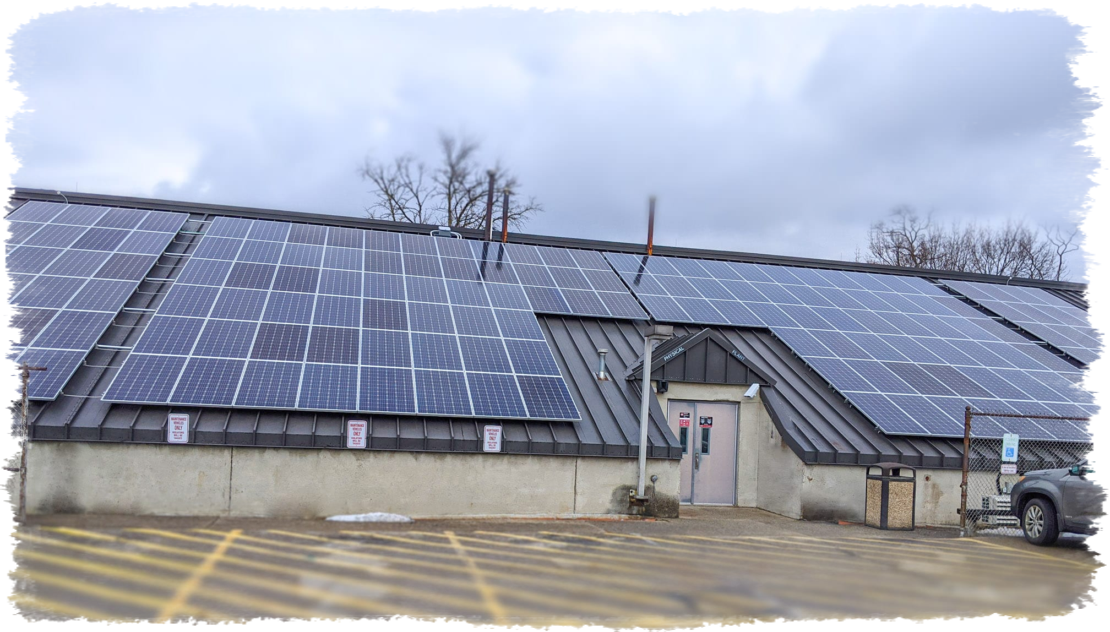
The North Campus array is the third one adopted by the school — in 2018, CCAC installed two other arrays at the West Hills Center and the Allegheny Campus on the North Side. However, the latest array is capable of a much larger energy-producing capacity compared to the first two, which generate 15 and 64 kilowatts, respectively.
The North Campus building array also marks the first time that CCAC will execute a Power Purchase Agreement, a tool used by tax-exempt organizations to obtain solar energy with little to no upfront financing. In the agreement, a third-party investor owns and maintains the solar array and host site, while the organization pays for the energy generated by the system.
Messer says that BAI Group, a civil engineering and environmental solutions design firm based in State College, Pa., will “build, operate and maintain the array, and CCAC will pay for the electricity at a contractually-defined, predictable rate.”
CCAC also plans to use the array as a teaching tool for various classes. Messer defines this more clearly, saying that students “will be able to use the array to explore concepts in physics, electricity and business.”
“CCAC has been serving its community for generations through transformative academic programs,” says Sel Edor, market director of renewables for BAI. “In our view, this solar project is another demonstration of CCAC’s commitment to its community, faculty, and students. ... More than a cost-saving measure, this 540kW solar project will serve as an educational tool that will help train the next generation of energy professionals.
Pennsylvania has a long history of energy leadership. We believe the state can lead in the clean energy transition as well. This CCAC solar project is a step in that direction.”
CCAC demonstrates a shift by higher education institutions in the region to commit to clean energy. In Feb. 2020, the University of Pittsburgh announced its campus would become carbon neutral by 2037, its 250th anniversary. Part of Pitt's plan included purchasing at least 50% of the campus electricity from renewable sources by 2030, including from a hydroelectric power plant in the Allegheny River slated to go online by 2023.
Carnegie Mellon University and others have also explored and invested in renewable energy sources in an effort to lower their carbon footprint and operational costs. In 2019, CMU announced it would, in addition to other sustainability initiatives, purchase energy from an Illinois wind farm for its Pittsburgh campus through 2024. As the proud alma mater of famed conservationist Rachel Carson, it's no surprise that Chatham University released a Climate Action Plan in 2008 set on making the school carbon neutral by 2025.
The new solar installation was facilitated in part by the Pennsylvania Solar Center, a project of the Pittsburgh-based community development nonprofit, New Sun Rising, and Hot Earth Collaborative, a company described on its website as working to advance a “clean energy economy” across Pennsylvania. CCAC went through the Center's GET Solar (Galvanizing our Energy Transition) program, which provides resources to those interested in switching to solar power.
Currently, the Center's GET Solar program is accepting the next round of applications from organizations interested in potentially switching to solar energy. Visit pasolarcenter.org or email info@pasolarcenter.org.
Leo Kowalski, GET Solar program manager for the Center, believes CCAC serves as a model for any non-profit or private entity looking for ways to be more green.
“CCAC is setting a new standard in the region for smart innovation and environmental stewardship,” said Leo Kowalski, GET Solar program manager for the Center. “This will be CCAC’s third major solar installation, so they’ve been a long-time leader in Pittsburgh for harnessing the power of solar energy.”
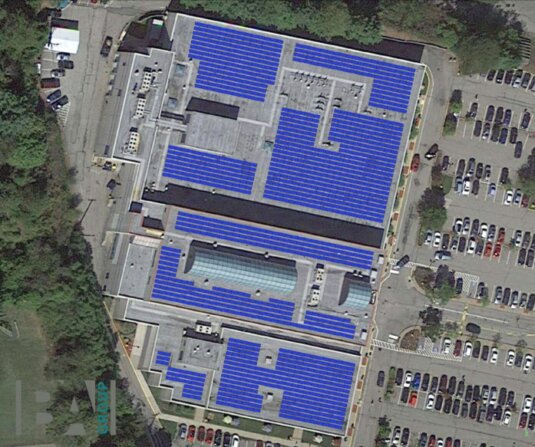
Rendering of the planned solar array for CCAC’s North Campus building.
Amanda Waltz
Amanda Waltz writes bi-weekly news stories on eco-tech/tourism for The Green Voice. She is also a senior staff writer at the Pittsburgh City Paper